
📌 Highlights
ABX-Accent evaluates rapid, unsupervised adaptation of speech representations across ten English accents using speaker-disjoint across-speaker ABX error. The strongest reported baseline, joint adaptive domain normalization plus fine-tuning, reduces average error from 16.1 for LibriSpeech pretraining alone to 12.3. The benchmark is valuable, but the method's dependence on known domain labels and its lack of downstream evaluation constrain deployment conclusions.
- Ten AESRC-derived English accent domains with unlabelled adaptation sets.
- Across-speaker ABX error measures phonetic discrimination; lower is better.
- Joint DN + FT reaches 12.3 average error versus 16.1 without adaptation.
- The adaptation recipe requires a supplied domain label and is evaluated only with ABX.
🎯 Introduction
Self-supervised speech learning assumes that large quantities of unlabelled audio are easier to obtain than transcribed speech, but unlabelled corpora remain skewed toward high-resource languages and dominant accents. Models trained on these distributions can therefore degrade out of domain and propagate accent-related bias into ASR, voice conversion, emotion recognition, or textless speech systems.
The paper treats accented speech as a continually renewed long-tail problem: geographic variation, generational change, and second-language speakers make exhaustive pretraining coverage unrealistic. Its objective is consequently to measure and improve rapid adaptation to a new accent with limited unlabelled audio. ABX-Accent provides the benchmark, while a CPC model with resampling and adaptive domain normalization provides an initial baseline.
🔬 Methodology
ABX-Accent is built from AESRC. Each of ten accents is divided into speaker-disjoint train, development, and test sets balanced for male and female speakers. Development and test each contain two hours per accent from six female and six male speakers, approximately ten minutes per speaker, plus a separate two-minute allocation for every speaker. Development and test transcriptions are phonemized and force-aligned with Kaldi; training audio remains untranscribed.
The evaluation adapts the Zero Resources Challenge ABX error. For phone-trigram minimal pairs A and B, it tests whether another instance X of A is closer to A than to B. The central across-speaker setting draws X from a different speaker than the A/B pair, making the metric sensitive to whether phonetic content survives speaker variation.
The CPC encoder contains five 1-D convolutional layers, while a two-layer LSTM produces the context representation used as the speech embedding. Adaptive normalization compresses intermediate activations, aggregates domain context, and predicts domain-conditioned scales and biases. Adaptation uses source/target resampling, a frozen-network normalization warm-up, and complete fine-tuning. Equation 3, which defines the aggregation weights, is omitted here because the supplied main-body source is syntactically malformed.
fig:abxdataset
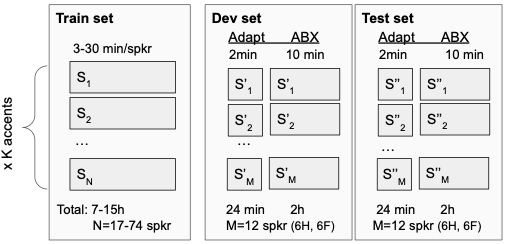
Caption: Structure of the benchmkark. Each of the K accent has a training set, a dev and a test set, each containing different speakers (K=10 accents). To allow for speaker adaptation, the dev and test set provide for each speaker a 2min adaptation set.
Why It Matters: This figure shows the benchmark's separation of speakers and the additional adaptation allocation.
tab:ABXtrain
Caption: Duration and number of speakers for the Train Set of ABX-Accent. Prefix "e-" highlights that the data is English speech.
| Accent | Acronym | Duration | Nb of speakers |
|---|---|---|---|
| American | e-us | 9:56h | 21 H, 25 F |
| British | e-uk | 15:06h | 38 H, 36 F |
| Canadian | e-ca | 8:07h | 9 H, 10 F |
| Chinese | e-ch | 8:23h | 14 H, 12 F |
| Indian | e-in | 7:34h | 8 H, 10 F |
| Portuguese | e-pt | 9:18h | 13 H, 15 F |
| Korean | e-ko | 8:24h | 11 H, 11 F |
| Japanese | e-ja | 8:25h | 11 H, 11 F |
| Russian | e-ru | 7:35h | 8 H, 9 F |
| Spanish | e-es | 8:06h | 10 H, 10 F |
Why It Matters: These are the benchmark's unlabelled target-domain training budgets and speaker counts.
equation 1
Meaning: The CPC objective predicts future latent representations against a negative set.
equation 2
Meaning: This compresses activations before domain-context aggregation.
equation 4
Meaning: Weighted transformed frames form the domain context.
equation 5
Meaning: The domain context generates adaptive scale and bias parameters.
📊 Experiments
The development experiment uses LibriSpeech train-clean with male and female speakers treated as two domains. A vanilla CPC model is trained on one sex and adapted to the other, with results averaged across both transfer directions. Target splits range from 2 minutes and one speaker to 16 hours and 479 speakers. Across-speaker ABX error is the reported test metric and lower values are better; average CPC accuracy drives early stopping.
Fine-tuning only on the new domain damages old-domain performance and can trigger early stopping. Resampling retains old-domain data and balances batches across the two domains. Domain normalization initially updates only domain statistics and W_g, W_β, W_γ while the network is frozen; full fine-tuning then continues with the network unfrozen. DN plus resampled fine-tuning obtains new-domain errors of 10.8, 9.31, 8.59, 8.19, and 8.04 across the five displayed data budgets, outperforming the other listed method in every row on the new domain.
The main benchmark is ABX-Accent, derived from AESRC and covering e-us, e-uk, e-ca, e-ch, e-in, e-ja, e-ko, e-pt, e-ru, and e-es. Baselines are MFCC, CPC trained directly on AESRC, LibriSpeech-pretrained CPC without adaptation, resampled fine-tuning in single-accent or joint form, and domain normalization plus fine-tuning in single-accent or joint form. Single-accent runs alternate LibriSpeech and one accent; joint runs cycle through LibriSpeech and all ten accents.
Joint DN + FT produces the best average ABX error, 12.3 ± 2, versus 16.1 ± 3 for LibriSpeech pretraining alone, corresponding to the paper's reported 23.6% relative improvement. It is strongest on seven displayed accent columns, while FT joint is best on e-us at 12.3 and DN + FT single is best on e-in at 11.0 and e-ru at 9.9. Russian therefore illustrates the paper's caveat that a specialized model can outperform a joint model even when joint training is strongest on average.
CPC_acc_MF
Caption: ABX scores (%) across speakers for CPC models trained on the Old domain (male or female LibriSpeech) and tested on the Old and New domains (the other sex). Lower scores are better and are averaged across males and females experiments. On average the baseline models only trained on the Old domain give 9.06% and 11.86% on the Old and New test sets respectively. Bold correspond to the best scores for each line and underline, overall. FT: simple fine tuning. resamp-FT: fine tuning with resampling. DN: domain normalization.
| Split / Domain | FT Old | FT New | resamp-FT Old | resamp-FT New | DN Old | DN New | DN+resamp-FT Old | DN+resamp-FT New |
|---|---|---|---|---|---|---|---|---|
| 2min 1 spk | 9.16 | 11.82 | 9.24 | 11.79 | 9.06 | 15.22 | 9.10 | 10.8 |
| 20min 10 spk | 9.31 | 11.42 | 9.17 | 11.15 | 9.10 | 13.68 | 9.15 | 9.31 |
| 2h 60 spk | 9.41 | 10.62 | 9.05 | 10.02 | 9.22 | 9.76 | 9.05 | 8.59 |
| 8h 240 spk | 9.57 | 9.74 | 8.89 | 9.38 | 9.09 | 8.98 | 8.89 | 8.19 |
| 16h 479 spk | 9.56 | 9.96 | 9.00 | 9.33 | 8.93 | 8.93 | 8.34 | 8.04 |
Why It Matters: This table is the method-selection ablation supporting resampling, normalization warm-up, and complete fine-tuning.
table: ABX_accents
Caption: ABX score across speakers within domain, on the accented English test set for different domain adaptation methods (FT: fine tuning with resampling, DN: domain normalization). We boldface the best results per columns.
| e-us | e-uk | e-ca | e-ch | e-in | e-ja | e-ko | e-pt | e-ru | e-es | Average | |
|---|---|---|---|---|---|---|---|---|---|---|---|
| MFCC | 37.9 | 37.3 | 35.5 | 32.7 | 33.5 | 36.2 | 32.6 | 35.0 | 35.2 | 35.6 | 35.1 ± 2 |
| AESRC | 16.1 | 14.9 | 22.4 | 16.0 | 17.1 | 20.1 | 21.9 | 15.5 | 18.6 | 16.3 | 17.9 ± 2 |
| LS pretrain | 13.1 | 13.2 | 20.3 | 14.2 | 15.4 | 19.4 | 20.6 | 13.7 | 16.5 | 14.7 | 16.1 ± 3 |
| FT (single) | 12.9 | 12.9 | 20.6 | 13.9 | 16.0 | 10.9 | 20.4 | 13.6 | 13.0 | 12.7 | 14.7 ± 3 |
| FT (joint) | 12.3 | 12.4 | 20.1 | 13.4 | 11.7 | 10.5 | 19.9 | 13.4 | 12.2 | 12.1 | 13.8 ± 3 |
| DN + FT (single) | 13.0 | 13.3 | 20.3 | 12.8 | 11.0 | 9.8 | 20.0 | 18.2 | 9.9 | 11.7 | 14.0 ± 4 |
| DN + FT (joint) | 13.2 | 11.8 | 18.2 | 9.0 | 11.7 | 9.7 | 13.4 | 12.1 | 12.1 | 11.6 | 12.3 ± 2 |
Why It Matters: This is the decisive benchmark comparison and exposes both the joint model's average advantage and accent-specific exceptions.
🔮 Conclusion
The paper establishes ABX-Accent as a benchmark for fast, unsupervised accent adaptation and demonstrates it with a CPC baseline using adaptive normalization. The authors summarize the controlled LibriSpeech male/female result as about a 33% relative ABX improvement and the accent result as about 23% relative, concluding that accent transfer is the more difficult setting.
Practically, the study supports keeping source data during adaptation and staging domain-normalization warm-up before full fine-tuning. It does not establish downstream utility, domain-label-free operation, or broad generalization beyond the benchmark's ten English accents.
🛠️ Future Research Improvements
The most immediate methodological improvement is to remove the requirement for known accent labels, for example by learning or inferring domain assignments while preserving the paper's limited-data constraint. The main body explicitly identifies unknown accent domains as a more serious problem than the male/female case.
Further work should evaluate stronger speech encoders, report downstream task transfer, test additional accents and languages, separate the effect of domain diversity from total adaptation duration, and define the uncertainty represented by the table's ± values. Reproductions should also verify the malformed domain-weight equation against an authoritative implementation.
🏭 Potential Industry Use Scenarios
A credible application is adapting a speech representation front end to a newly encountered customer or regional accent before integrating it into ASR, voice conversion, or other speech products. This is a reviewer interpretation supported by the paper's representation-learning setting; the paper does not itself demonstrate downstream product gains.
The benchmark could also support accent-robustness audits, model selection, and controlled testing of personalization methods using small amounts of unlabelled speech. Any deployment would need a strategy for obtaining or inferring the domain label and should validate privacy, latency, and downstream accuracy separately.
💬 Critical Analysis
The strongest aspect is experimental structure: the paper introduces a speaker-disjoint benchmark, defines a content-oriented across-speaker metric, and uses a controlled male/female transfer task to justify the final adaptation recipe. The tables preserve useful data-budget and per-accent detail instead of reporting only one aggregate.
The main result is meaningful within that protocol: 12.3 average ABX error for joint DN + FT versus 16.1 without adaptation. However, the per-accent results show that joint training is not uniformly best, and the paper's statement that specialized models perform better on average is difficult to reconcile with the displayed 14.0 single-domain versus 12.3 joint DN + FT averages.
Reproducibility and scope remain open questions. The paper announces benchmark resources, but the supplied main body provides no code URL; Equation 3 is malformed; uncertainty notation is unexplained; and the evaluation does not include statistical testing or downstream tasks. Most importantly, reliance on an explicit domain label shifts part of the real-world accent-recognition problem outside the proposed adaptation system.