
📌 Highlights
TripleFlow argues that video object removal is harder than semantic replacement because the prompt identifies what to erase but does not describe the exact occluded background that must be reconstructed.
The method is training-free and inversion-free: it uses a frozen video diffusion/flow backbone and coordinates three inference-time flows rather than fitting a specialized inpainting model.
The strongest reported result is broad: TripleFlow posts the best CORE score in the supplied table on DAVIS, WIPER-Bench, PROVE-M, PROVE-H, and ROSE, and the best PSNR, SSIM, and LPIPS on paired PROVE-M and ROSE.
The main caveat is that practical quality depends on accurate masks and a clean first-frame reference F_0, while several implementation and ablation details are referenced outside the main body.
- Core claim: continuous coupling of erasure and generation reduces ghosting and improves background reconstruction.
- Best listed CORE: 3.394 on DAVIS, 3.576 on WIPER, 3.154 on PROVE-M, 3.275 on PROVE-H, and 3.325 on ROSE.
- Best listed paired reconstruction: PROVE-M PSNR 24.636, SSIM 0.8644, LPIPS 0.1724; ROSE PSNR 27.387, SSIM 0.9112, LPIPS 0.1053.
- Key limitation: the main body does not fully expose the appendix implementation details that the reproducibility statement says are needed.
🎯 Introduction
The paper starts from a concrete failure mode in general-purpose video editing. Replacement tasks can rely on a positive prompt, such as changing one object into another, but removal prompts only specify a target to erase. The exposed background must be the specific scene surface hidden by the object, not any plausible generated content.
Prior training-free editors can preserve source alignment through source-relative velocity differences, but the paper argues that this mainly behaves like localized erasure. It can suppress the object yet fail to synthesize the hidden background, leaving ghosting, blur, or structural mismatch.
TripleFlow's objective is to make removal and completion interact from the beginning of sampling. The source flow anchors the observed video, the residual flow removes the object, and the synthesis flow supplies native generative momentum for the occluded background.
fig:editing_vs_removal

Caption: Object removal with general-purpose video editors. Given an empty-road prompt, FlowDirector~ flowdirector and DNAEdit~ dnaedit retain vehicles, while RF-Edit~ rfedit removes the car but substantially changes the road and surroundings.
Why It Matters: This motivates the paper by showing that general-purpose editors can either fail to remove the target or damage the surrounding scene.
🔬 Methodology
The setup assumes a source video V, frame-wise mask M, and clean reference first frame F_0. The generator and causal VAE remain frozen. Source video X, source first-frame condition a^S, and clean target condition a^T are encoded in latent space, and sampling proceeds over decreasing noise levels t_1=1 to t_K=0.
TripleFlow constructs a source trajectory S_k analytically, then forms a target query B_k by adding the source-path offset to the current edit estimate Z_k. The frozen model predicts v_k^S under the source condition and v_k^T under the target condition. The residual flow uses their difference to remove the object locally, while the synthesis flow uses v_k^T directly to generate missing content.
The synthesis state is projected into the hard edit support A, converted back into clean-space as \widetilde Z_{k+1}, and mixed with the residual estimate R_{k+1}. This mixed Z_{k+1} becomes the next target query, so synthesized background continuously influences later velocity predictions.
Localization uses segmentation-derived masks rather than internal attention maps. The mask is converted into hard support A and soft weight W, while early attention control scales masked keys and biases masked query-key pairs to reduce feature leakage from the removed object.
equation 1
Meaning: Defines the source-aligned analytic trajectory used as a reference for preserving original structure and motion.
equation 2
Meaning: Places the current edit estimate at noise level t_k so source and target velocities are comparable.
equation 3
Meaning: Defines the source and target velocity predictions from the frozen flow model.
equation 4
Meaning: Uses the velocity difference for localized residual removal while preserving the unedited scene.
📊 Experiments
The paper evaluates on DAVIS, WIPER-Bench, ROSE, and PROVE, with PROVE split into PROVE-M and PROVE-H in the result table. ROSE and PROVE-M provide paired clean ground truths for reconstruction metrics, while PROVE-H contains challenging in-the-wild videos without paired references. Baselines are OmnimatteZero, Object-WIPER, ContextFlow, and OmniEraser applied independently to video frames.
For object and associated-effect removal, the paper reports CORE as the mean of ObjectScore and AftereffectScore, with higher being better. TripleFlow reports the highest CORE in every listed benchmark table column: 3.394 on DAVIS, 3.576 on WIPER, 3.154 on PROVE-M, 3.275 on PROVE-H, and 3.325 on ROSE.
For paired reconstruction, the paper reports PSNR, SSIM, and LPIPS on PROVE-M and ROSE. TripleFlow records PROVE-M PSNR 24.636, SSIM 0.8644, LPIPS 0.1724 and ROSE PSNR 27.387, SSIM 0.9112, LPIPS 0.1053. The text states its PSNR exceeds the strongest competing results by nearly 4 dB on PROVE-M and 2 dB on ROSE, and notes that OmniEraser has similar PROVE-M CORE but much worse LPIPS.
Qualitative and ablation evidence supports the flow decomposition. The full model removes foreground subjects while preserving scene geometry; removing source flow causes drift and object-shaped artifacts, removing residual flow leaves objects largely present, removing synthesis flow weakens completion detail, and removing editing control creates leakage and boundary artifacts.
- Benchmarks named in the main body: DAVIS, WIPER-Bench, ROSE, PROVE-M, and PROVE-H.
- Baselines named in the main body: OmnimatteZero, Object-WIPER, ContextFlow, and OmniEraser.
- Metrics named in the main body: CORE, PSNR, SSIM, LPIPS, plus figure-level references to tLP and tOF.
- Human evaluation: TripleFlow receives a 56.7% first-place preference rate on ten showcase videos, versus 23.3% for OmnimatteZero.
fig:qualitative_results
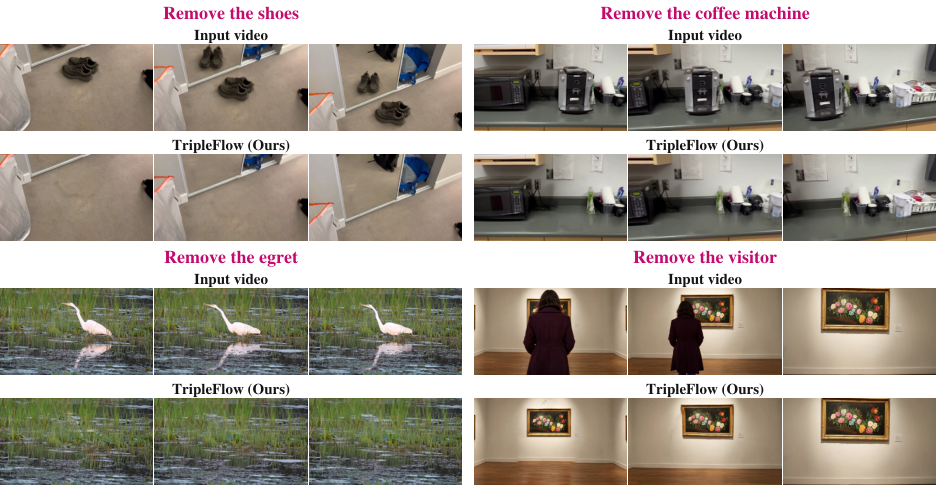
Caption: Video object removal under camera motion. TripleFlow removes foreground subjects and reconstructs temporally coherent backgrounds while preserving the original camera motion and scene structure.
Why It Matters: This shows the target operating condition: removal with camera motion and temporal background consistency.
tab:core_benchmarks
Caption: Video object removal results. CORE is computed as the mean of ObjectScore and AftereffectScore (higher is better).
| Method | DAVIS $ $ | WIPER $ $ | PROVE-M $ $ | PROVE-H $ $ | ROSE $ $ |
|---|---|---|---|---|---|
| OmnimatteZero | 2.917 | 3.188 | 2.576 | 3.167 | 3.260 |
| ObjectWiper | 2.056 | 2.375 | 2.232 | 2.389 | 2.625 |
| ContextFlow | 2.667 | 3.500 | 2.438 | 3.111 | 2.357 |
| OmniEraser | 3.000 | 3.188 | 3.125 | 2.889 | 2.929 |
| \ (Ours) | 3.394 | 3.576 | 3.154 | 3.275 | 3.325 |
Why It Matters: It supports the headline claim that TripleFlow leads the listed object-removal benchmark results.
tab:reconstruction_metrics
Caption: Reconstruction quality against ground truth labels on PROVE-M and ROSE.
| Method | PROVE-M | ROSE | ||||
|---|---|---|---|---|---|---|
| PSNR $ $ | SSIM $ $ | LPIPS $ $ | PSNR $ $ | SSIM $ $ | LPIPS $ $ | |
| \ | 24.636 | 0.8644 | 0.1724 | 27.387 | 0.9112 | 0.1053 |
| OmnimatteZero | 20.894 | 0.8106 | 0.2819 | 25.450 | 0.8687 | 0.1877 |
| ObjectWiper | 16.608 | 0.6616 | 0.4129 | 18.897 | 0.6893 | 0.3655 |
| ContextFlow | 17.951 | 0.7912 | 0.3144 | 22.015 | 0.8912 | 0.1599 |
| OmniEraser | 19.044 | 0.7881 | 0.3407 | 19.649 | 0.7848 | 0.2741 |
Why It Matters: It verifies that the method improves not only removal scores but also reconstruction fidelity against paired ground truth.
🔮 Conclusion
The paper concludes that object removal benefits from coupling target erasure and scene reconstruction inside the sampling process. TripleFlow uses a source flow to preserve the input, a residual flow to suppress the foreground object, and a synthesis flow to reconstruct exposed background.
The practical takeaway for builders is that the method treats generated background as an active control signal. By injecting synthesis back into the edit state at every step, it aims to avoid the ghosting and structural distortion seen when removal is handled as a purely residual edit or late patch.
The main-body evidence supports strong comparative results across five benchmarks and paired reconstruction metrics, plus qualitative removal of associated effects such as mirror and water reflections.
🛠️ Future Research Improvements
A clear next improvement is reducing dependence on the clean first-frame reference pipeline. The main body states that F_0 may come from an unoccluded frame or an off-the-shelf image model, and that a vision-language model finds frames showing hidden background; robustness under poor reference selection remains an important engineering question.
Another direction is stronger mask-error tolerance. Because A, W, first-frame anchoring, and attention control all depend on mask quality, future work should test imperfect segmentation, thin structures, reflections, shadows, and masks that miss associated effects.
The paper references implementation details, sampling hyperparameters, baseline configurations, and additional ablations outside the main body. Reproducibility would benefit from moving more of those operational details into the main method or a directly inspectable implementation artifact.
- Test sensitivity to segmentation mask quality and boundary dilation.
- Benchmark failure modes when F_0 is generated rather than taken from an unoccluded frame.
- Add main-body quantitative ablations for source flow, residual flow, synthesis flow, and editing control.
- Evaluate longer videos and more complex object-associated effects beyond the supplied benchmark evidence.
🏭 Potential Industry Use Scenarios
The strongest industry fit is video post-production tooling where users need to remove people, vehicles, product stands, supports, shadows, or reflections from footage without training a project-specific model. The main-body examples explicitly include camera motion, cast shadows, mirror reflections, support removal, and associated physical effects.
The method is also relevant to creative editing systems that already run pretrained video generation backbones and need a zero-shot removal mode. Because TripleFlow is training-free and reuses a frozen backbone, integration could be framed as an inference-time controller around an existing generator rather than a new model-training program.
Operational deployment still needs validation around masks, reference-frame generation, runtime, and temporal consistency on production footage. The paper reports a performance-speed trade-off figure and says TripleFlow runs faster than flow-based editing baselines such as ContextFlow, but the main-body extraction does not provide exact runtime numbers.
- Creator tools for removing foreground objects while preserving camera motion.
- Film and advertising cleanup workflows involving stands, reflections, or unwanted people.
- Dataset curation pipelines that need plausible removal of distracting objects from videos.
- Interactive video editing products where training-free operation is valuable.
💬 Critical Analysis
TripleFlow's strongest technical idea is that completion should shape the edit trajectory, not arrive as a post-hoc fill. The equations make that explicit: residual removal and native synthesis share v_k^T, then the mixed state becomes the next target query. That design is plausibly responsible for the qualitative improvements in structural detail and the quantitative gains in LPIPS, PSNR, and SSIM.
The evidence is broad for a video object removal paper: the main body names five benchmark splits, multiple training-free baselines, an image-removal baseline applied per frame, paired reconstruction metrics, CORE removal scores, qualitative comparisons, and ablations. The tables show a consistent advantage, with particularly large reconstruction gaps against ObjectWiper and ContextFlow.
The remaining concern is reproducibility from the main body alone. Important practical pieces are named but not fully specified in the supplied main-body evidence: exact sampling hyperparameters, clean first-frame generation settings, detailed human-evaluation protocol, and quantitative ablation values. Builders should treat the method as promising but verify the implementation details before assuming it transfers cleanly.
The paper-reviewer scores align with that reading: novelty and technical strength are solid because the flow coupling is a concrete inference-time mechanism, while significance depends on whether the reference-frame and mask pipeline remains reliable outside curated benchmarks.
- Strength: strong trajectory-level formulation with direct equations and result tables.
- Strength: evaluates both removal quality and reconstruction fidelity rather than only visual examples.
- Risk: upstream mask and clean-reference quality are central and may dominate real-world failures.
- Risk: appendix-referenced details are needed for exact reproduction but are outside the allowed evidence boundary here.
equation 8
Meaning: Clarifies that residual and synthesis estimates diverge because they evolve relative to different source references, motivating explicit coupling.