
📌 Highlights
StrAD asks whether native streaming anomaly detectors actually outperform static TSAD methods deployed online when data arrive sequentially. The answer reported in the main body is mostly no: online TSAD methods dominate accuracy on real-world TSAD streams, while streaming methods mainly retain advantages in computational efficiency and drift resilience.
The paper's strongest builder lesson is that update mechanisms alone do not solve streaming TSAD. Current streaming algorithms are often inherited from point-wise outlier detection and therefore miss collective, subsequence-level anomalies that define many real time-series failures.
- Benchmark scope: 17 real-world datasets, 19 static/online TSAD methods, and 10 streaming anomaly-detection methods.
- Main metric: AUC-PR, chosen over AUC-ROC because anomaly detection datasets are highly imbalanced.
- Main accuracy result: online methods outperform streaming methods on TSB-AD-M, including a reported 64% average gain at full training size in the training-size ablation discussion.
- Drift result: streaming methods are more resilient on TSB-drift, but their robustness does not reverse the absolute-accuracy ranking.
- Efficiency result: streaming methods occupy the high-throughput end of the Pareto frontier, while accurate methods are mainly online models with higher structural capacity.
🎯 Introduction
The paper targets unsupervised multivariate time series anomaly detection in streaming settings. The motivating deployment setting is common in industrial control, energy, healthcare, and IoT: data arrive continuously, labels are unavailable to the detector, and the distribution may shift over time.
The authors argue that the streaming anomaly-detection literature and TSAD literature have drifted apart. Streaming methods often treat streams as generic sequences of independent points, while TSAD anomalies often appear as subsequences or collective temporal patterns. This creates a mismatch between what streaming algorithms optimize and what real-world TSAD requires.
The paper frames four research questions: whether static TSAD beats online TSAD, whether streaming methods beat online methods in streaming settings, whether streaming methods become preferable under concept drift, and whether streaming methods provide the best accuracy-efficiency trade-off. The objective is not to propose a new detector, but to benchmark these assumptions under a unified framework.
🔬 Methodology
StrAD defines static methods as models that may score each timestamp using the entire multivariate time series, online methods as models trained on an initial batch B0 and then frozen, and streaming methods as sequential models that may update their internal state after scoring incoming observations. This separation is important because many static TSAD models can be deployed online without retraining.
The benchmark starts from TSB-AD-M, which contains 200 multivariate real-world time series from 17 datasets. The predefined training segment is used as B0 for online and streaming methods. If preprocessing is needed, z-score standardization is fitted only on B0 and then applied to the incoming stream, keeping normalization causal and avoiding contamination from anomalous windows.
TSB-drift is built by subdividing each multivariate series into consecutive batches of training-batch size, estimating empirical distributions per dimension, computing KL and Jensen-Shannon divergences across batch pairs, aggregating across dimensions with a max operation, and ranking time series by maximum and mean drift matrix values. The authors retain the top 75 time series as high-confidence drift cases.
tab:datasets
Caption: Datasets in StrAD. Drift: \# of TS with Concept Drift, \% of Dimensions with Drifts (ratio), and Type
| Dataset | Category (Field) | # TS | $\mu(D)$ | # TS with drift | ratio | Type |
|---|---|---|---|---|---|---|
| Genesis | Sensor (Robotics) | 1 | 18 | 0/1 | 0% | $\emptyset$ |
| MITDB | Medical | 13 | 13 | 0/13 | 0% | $\emptyset$ |
| PSM | Facility | 1 | 25 | 0/1 | 0% | $\emptyset$ |
| SVDB | Medical | 31 | 2 | 0/31 | 0% | $\emptyset$ |
| MSL | Sensor (Aerospace) | 16 | 16 | 0/16 | 0% | $\emptyset$ |
| Daphnet | Human Activity | 1 | 9 | 1/1 | 11% | $\{CP\}$ |
| GHL | Sensor (Industry) | 25 | 19 | 23/25 | 15% | $\{C,CP,RW\}$ |
| SMD | Facility | 22 | 38 | 15/22 | 13% | $\{C,CP,P,RW\}$ |
| LTDB | Medical | 5 | 2 | 1/5 | 67% | $\{P\}$ |
| TAO | Environment | 13 | 3 | 8/13 | 54% | $\{C\}$ |
| OPP. | Human Activity | 8 | 248 | 7/8 | 23% | $\{CP,RW\}$ |
| CreditCard | Finance | 1 | 29 | 1/1 | 3% | $\{CP\}$ |
| CATSv2 | Sensor (Dynamic System) | 6 | 17 | 5/6 | 20% | $\{C,P,RW\}$ |
| SMAP | Sensor (Telemetry) | 27 | 25 | 5/27 | 4% | $\{C,CP\}$ |
| SWaT | Sensor (Cybersecurity) | 2 | 59 | 1/2 | 2% | $\{C,CP\}$ |
| GECCO | Sensor (Water quality) | 1 | 9 | 1/1 | 11% | $\{C\}$ |
| Exathlon | Facility | 27 | 21 | 5/27 | 5% | $\{CP,RW\}$ |
Why It Matters: It grounds the benchmark in the real-world datasets and drift categories used in the experiments.
tab:StreamingMethods
Caption: Streaming TSAD in StrAD ($^*$: Independent to $D$ but Dependent to model hyper-parameters)
| Acronym | Method | UM (Sec 2.2.2) | MM (Sec 2.2.3) | Complexity |
|---|---|---|---|---|
| LODA | LODA | Projections | Tumbling Window | $O(D)$ |
| xS | xStream | Projections | Tumbling Window | $O(D)$ |
| RSH | RSHash | Partitioning | Sliding Window (Point) | $O(1)^*$ |
| HST | HSTree | Partitioning | Tumbling Window | $O(1)^*$ |
| SDOs | SDOstream | Partitioning | Soft Forgetting (Aging) | $O(D)$ |
| RRCF | RRCF | Tree | Sliding Window (Point) | $O(\log(\ell))$ |
| MCOD | MCOD | Clustering | Sliding Window (Point) | $O(D)$ |
| LEAP | LEAP | Proximity | Sliding Window (Batch) | $O(D)$ |
| SKNN | SWKNN | Proximity | Sliding Window (Point) | $O(D)$ |
| MemS | MemStream | Encoding | Soft Forgetting (Selective) | $O(D)$ |
Why It Matters: It identifies the update and memory strategies being tested rather than treating streaming methods as a single family.
equation 1
Meaning: It quantifies distributional change between two batches for a single dimension.
equation 2
Meaning: It makes the drift measure symmetric and bounded before aggregation across batches and dimensions.
📊 Experiments
The empirical study uses TSB-AD-M and the derived TSB-drift subset. It evaluates static, online, and streaming models in an unsupervised multivariate setting, with labels used only for evaluation. AUC-PR is the primary metric because the authors argue it is more appropriate than AUC-ROC for highly imbalanced anomaly detection.
For Q1, the static-vs-online comparison shows no universal winner. Proximity-based models such as LOF and KNN can improve online because local context reduces anomaly camouflage, while density-based models such as Isolation Forest can degrade because the frozen training-batch distribution becomes stale under drift. Window-based deep methods can change little because their architecture is already local.
For Q2, the online-vs-streaming comparison is the headline result: online methods significantly outperform streaming methods on average. The paper reports that the advantage persists when the initial training size is reduced, with online methods showing average gains of 64% at full training size, 49% at 75% training size, and 47% at 50% training size. The authors attribute the gap partly to streaming models' focus on point outliers and weaker modeling of collective temporal anomalies.
For Q3 and Q4, the story becomes operationally nuanced. On TSB-drift, streaming methods are closer to their non-drift performance and 70% of streaming methods show lower degradation than 70% of online methods, but absolute top performers remain online. In scalability experiments, streaming methods dominate the high-efficiency region, while the paper reports that even the slowest frontier method, CNN, maintains a mean throughput of 770 points scored per second.
- Benchmarks named in the main body: TSB-AD-M, TSB-AD-M-Tuning, TSB-AD-M-Eval, TSB-drift, and TSB-¬drift.
- Metric direction: higher AUC-PR is better.
- Evaluation scope: real-world multivariate TSAD with unsupervised training and labels reserved for evaluation.
- Point-anomaly subset: used to test whether streaming methods become more competitive when the anomaly type matches point-wise outlier assumptions.
tab:TSADmethods
Caption: Static/Online TSAD Methods in StrAD ($^*$: For Online settings, $|T|$ is the Size of the Initial Batch $ B_0$)
| Acronym | Method | Type | Complexity |
|---|---|---|---|
| LOF | LOF | Proximity | $O( |
| KNN | $k$-NN | Proximity | $O( |
| KMAD | $k$-Means | Clustering | $O(D)$ |
| CBLOF | CBLOF | Clustering | $O(D)$ |
| IF | Isolation Forest | Tree | $O(\log( |
| MCD | MCD | Distribution | $O(D^2)$ |
| HBOS | HBOS | Distribution | $O(D)$ |
| SVM | OCSVM | Distribution | $O(D)$ |
| PCA | PCA | Encoding | $O(D)$ |
| RPCA | RobustPCA | Encoding | $O(D)$ |
| CNN | CNN | Forecasting | $O(\ell D)$ |
| LSTM | LSTMAD | Forecasting | $O(\ell D)$ |
| AT | AnomalyTransformer | Reconstruction | $O(\ell^2D + \ell D^2)$ |
| AE | AutoEncoder | Reconstruction | $O(\ell D)$ |
| TrAD | TranAD | Reconstruction | $O(\ell^2D + \ell D^2)$ |
| TN | TimesNet | Reconstruction | $O(\ell \log(\ell)D)$ |
| USAD | USAD | Reconstruction | $O(\ell D)$ |
| OA | OmniAnomaly | Reconstruction | $O(\ell D)$ |
| FITS | FITS | Reconstruction | $O(\ell \log(\ell)D)$ |
Why It Matters: It documents the online/static comparator set used in the experiments.
fig:probdef

Caption: Static, Online, and Streaming Time Series Anomaly Detection
Why It Matters: It defines the three evaluation regimes that drive the benchmark: full-series static scoring, fixed-model online scoring after B0, and sequential scoring with updates.
fig:schema_drift

Caption: Illustration of TSB-drift Construction
Why It Matters: It shows how the authors move from batch subdivision to pairwise divergence matrices, max aggregation across dimensions, and final selection of drift-heavy time series.
fig:static_vs_online
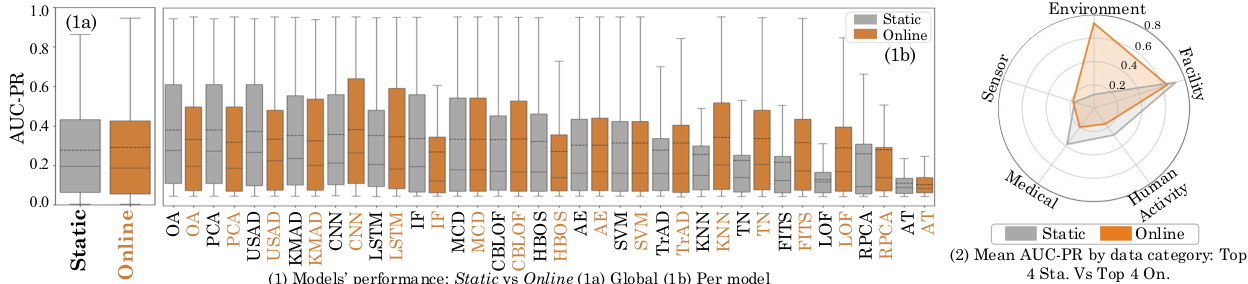
Caption: Static vs. Online Accuracy Evaluation on TSB-AD-M: (1) Overall, (2) by Data Category.
Why It Matters: It supports the Q1 finding that neither static nor online dominates universally; behavior varies by method family and data category.
fig:online_streaming

Caption: Online vs. Streaming Accuracy on TSB-AD-M: (1) Overall, (2) by Data Category, (3) Critical Difference Diagrams ($ = 0.05$) on (3a) TSB-AD-M and (3b) Point Anomalies Time Series.
Why It Matters: It is the main result figure showing online methods outperform streaming methods overall, while streaming methods become more competitive on point-wise anomaly time series.
fig:drift_eval
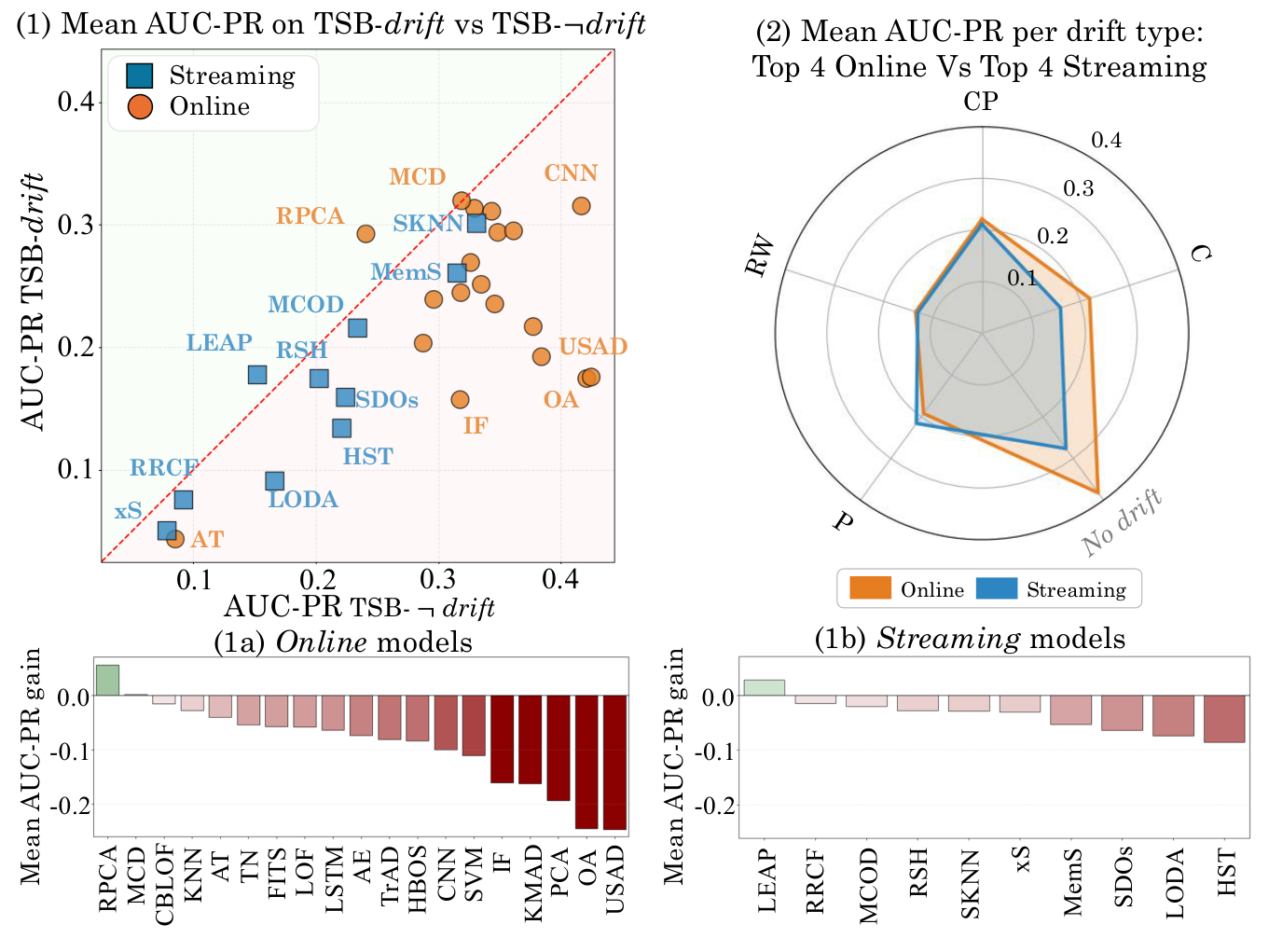
Caption: (1) TSB-drift vs TSB-$ $drift accuracy; Mean AUC-PR gain of TSB-drift on TSB-$ $drift for (1a) Online models and (1b) Streaming models; (2) Mean performance on drift-types
Why It Matters: It supports the nuanced drift result: streaming methods are more resilient to drift, but that resilience does not overcome their lower absolute accuracy.
fig:time_eval
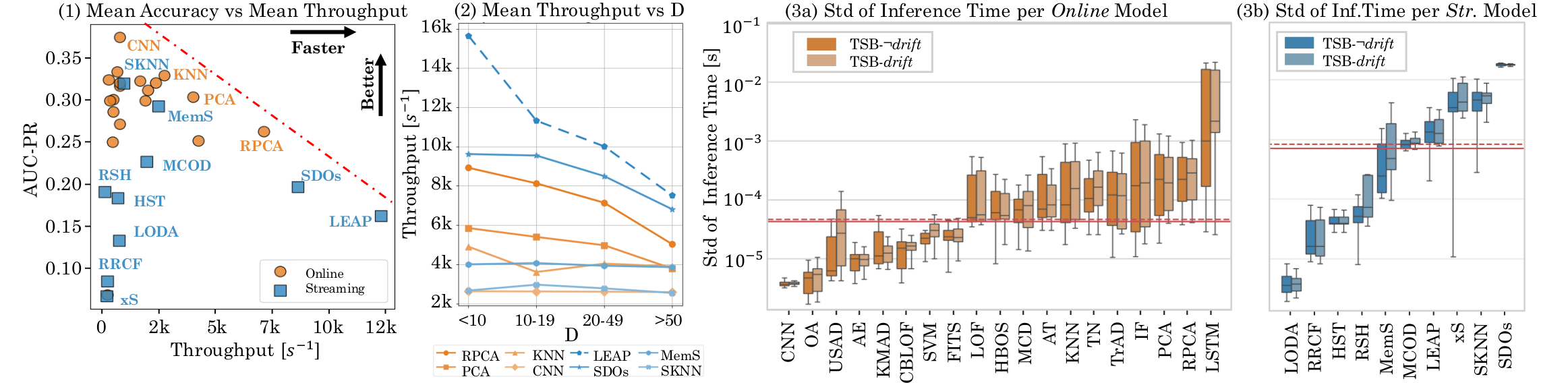
Caption: Scalability Evaluation on TSB-AD-M: (1) Accuracy vs Throughput; (2) Throughput vs Number of Dimensions; (3) Inference time standard deviation on TSB-$ $drift and TSB-drift for (3a) Online and (3b) Streaming models (Red line highlights median on TSB-$ $drift and dotted line on TSB-drift)
Why It Matters: It frames model choice as an accuracy-throughput-stability trade-off rather than a one-dimensional ranking.
🔮 Conclusion
The paper concludes that online TSAD methods often perform better because they reduce anomaly camouflage relative to full static scoring while retaining stronger temporal modeling capacity than lightweight streaming methods. Fourier-based online models can focus on local periodicities, and high-capacity deep models can capture temporal dependencies that streaming outlier detectors miss.
The authors' main limitation finding is that current streaming TSAD inherits too much from point-wise outlier detection. Real-world anomalies often appear as collective pattern changes rather than isolated spikes, so efficient updates and forgetting mechanisms do not guarantee useful anomaly representations.
The practical conclusion is conditional: in a streaming world, builders should often 'stand still' by using a frozen online TSAD model when accuracy matters and latency permits. Streaming methods still matter for high-velocity, memory-constrained cases, but the paper argues that future work should redesign streaming TSAD around collective anomalies.
🛠️ Future Research Improvements
A direct research direction is streaming TSAD for collective anomalies. The benchmark suggests that adapting point-outlier methods is not enough; future models need online update rules that preserve temporal context, subsequence structure, and cross-dimensional dependency signals.
The paper also points toward streaming automated anomaly detection. Static AutoAD has been effective for model selection and performance improvement, but the authors state that extending this idea to streaming scenarios remains largely unexplored.
A stronger future benchmark would expose more numeric result tables in the main paper, stratify results by anomaly type more explicitly, and include additional operational constraints such as memory budgets, update cost, and inference-time tail latency.
- Develop streaming detectors that model subsequences rather than isolated observations.
- Design update mechanisms that adapt without destroying learned temporal representations.
- Extend automated anomaly-detection model selection to streaming settings.
- Report drift-specific accuracy, runtime variance, and memory usage together.
🏭 Potential Industry Use Scenarios
For industrial monitoring, energy systems, healthcare sensors, and IoT platforms, the paper supports starting with online TSAD baselines when data rates allow. These deployments often care about collective anomalies, sequence context, and reliable detection more than the mere existence of a model-update mechanism.
For high-velocity network, telemetry, or embedded settings, the paper supports keeping streaming methods in the toolkit. Their lower computational footprint and high throughput can be decisive when deep online models cannot meet latency, memory, or data-rate constraints.
For environments with known drift, the result suggests a hybrid design: use online TSAD as the accuracy anchor, but monitor drift and runtime stability, then selectively update, recalibrate, or switch models when the fixed reference batch becomes stale.
- High-precision monitoring: use online CNN, USAD, TimesNet, KNN-style baselines where throughput permits.
- Resource-constrained streaming: consider SDOstream, LEAP, SWKNN, MemStream, or related streaming families when speed and memory dominate.
- Drift-heavy operations: evaluate both absolute AUC-PR and degradation from TSB-¬drift-like to TSB-drift-like regimes.
- Model governance: track inference-time variance, because streaming updates can add operational instability under drift.
💬 Critical Analysis
The paper's main strength is conceptual hygiene. By separating static, online, and streaming methods, it avoids the common mistake of equating real-time scoring with model updating. That distinction makes the benchmark directly useful for builders deciding whether a live anomaly detector really needs online adaptation.
The result is compelling because it cuts against intuition while still preserving deployment nuance. The authors do not claim streaming is useless; they show that streaming methods are less accurate on broad real-world TSAD, more resilient under drift, and still important for high-throughput regimes.
The main caution is that the extracted main-body evidence is richer in figures than in numeric result tables. Several decisive comparisons are presented visually or in prose rather than as fully recoverable tables, so downstream readers should inspect the PDF and released repository before treating individual method rankings as fixed.
Reproducibility is helped by the reported code availability and by the explicit method lists, datasets, metric choice, normalization policy, and implementation sources. Still, builders should re-run the benchmark on their own anomaly mix, because the paper itself shows that model ranking depends strongly on anomaly type, drift type, data category, and throughput constraints.